Verifier-in-the-Loop: Why 2026's Production Agents Ship With Built-In Evaluation
For two years the agent conversation was about capability: longer context, better tool use, more autonomy. In 2026 the bottleneck has shifted. Getting an agent to do something is no longer the hard part. The hard part is getting it to prove it did the right thing, every time, in production, without a human reading the transcript.
That shift has a name we keep coming back to, the verifier-in-the-loop. The most reliable agent systems being deployed today don't treat evaluation as a notebook you open after an incident. The verifier is a runtime component that sits inside the loop and gates actions before they reach the user.
The reliability gap nobody budgets for
A demo agent and a production agent look identical for the first hundred runs. The difference shows up in the tail. An agent that is "95% correct" sounds excellent until you run it ten thousand times a day. That's 500 wrong outcomes daily, and the wrong ones are rarely random. They cluster around the exact edge cases your evaluation never covered.
Traditional software handles this with tests, types, and assertions. Agents broke that model because their output space is open-ended. There's no single expected value to assert against when a response can be correct in a thousand different phrasings. So teams shipped agents with the one thing they'd never accept anywhere else in their stack: no verification layer at all.
An agent without a verifier is an unreviewed pull request that merges itself to production on every request.
What "verifier-in-the-loop" actually means
The pattern is simple to state and demanding to build. Every consequential step an agent takes is scored by an independent process before its effects are committed. A planner decomposes the goal. An executor takes an action, whether that's a tool call, a generation, or a write. A verifier scores the action against the task's success criteria, and a gate decides what happens next: commit, retry with feedback, or escalate to a human.
The verifier is not the same model doing a victory lap on its own work. It's a separate scorer, sometimes an LLM judge with a rubric, sometimes a deterministic check, often both, whose only job is to be skeptical.
| Layer | Question it answers | Failure mode it catches |
|---|---|---|
| Schema / deterministic check | "Is this well-formed and within policy?" | Malformed output, PII leaks, out-of-bounds actions |
| LLM judge with rubric | "Does this actually satisfy the intent?" | Plausible-but-wrong answers, missed constraints |
| Trajectory scorer | "Did the agent take a sane path to get here?" | Right answer, dangerous route; tool misuse |
| Regression gate | "Is this worse than last week's version?" | Silent quality drift after a prompt or model change |
We simulated the gate, imperfections included
It's fair to ask how much an imperfect verifier is really worth, so we ran the numbers as a Monte Carlo over 100,000 tasks. The agent is the "95% correct" agent from earlier, made honest: 80% easy tasks at 3% error, 20% hard tasks at 13%. A verifier with a given sensitivity (errors caught) and false-alarm rate (good outputs wrongly flagged) gates every output; flagged outputs retry up to a budget, and anything still flagged escalates to a human. One detail matters more than it looks:
# retries are correlated with the task, not independent coin flips:
# a hard task stays hard on retry
bad = np.where(active, rng.random(N) < err_p, bad)
| verifier | retries | shipped errors | reduction | compute overhead | escalated |
|---|---|---|---|---|---|
| none | 0 | 5.00% | 1x | 0% | 0% |
| weak (70% / 5%) | 1 | 1.58% | 3.2x | 8.3% | 0.7% |
| solid (90% / 5%) | 1 | 0.60% | 8.4x | 9.2% | 0.9% |
| solid (90% / 5%) | 2 | 0.58% | 8.6x | 10.4% | 0.1% |
| excellent (99% / 2%) | 1 | 0.07% | 76.9x | 6.9% | 0.6% |
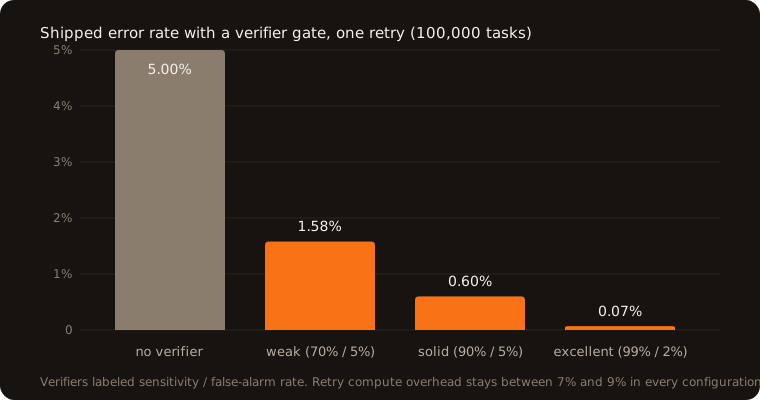
The 500 wrong outcomes a day become about 60 with a solid verifier and one retry, for roughly 9% extra compute and under 1% of tasks reaching a human. Two findings surprised us enough to reshape how we budget verification. First, shipped error has a hard floor of (1 - sensitivity) times the error rate: what the verifier never flags, it can never stop, which is why a second retry barely moves shipped errors and mostly serves to collapse escalations (0.9% to 0.1%). Second, verifier quality dominates retry budget everywhere. Engineering hours spent raising sensitivity beat compute spent on more retries, at every configuration we tested. Code and verbatim output are in our repo's experiments directory.
Self-verification is not self-grading
A common objection: doesn't asking a model to check itself just inherit the same blind spots? It does, if you do it naively. The fix is independence by construction. You change what the verifier sees and how it's incentivized. Give it a different lens than the executor (correctness, safety, does-it-reproduce) rather than a generic "is this good?". Prompt it to refute, defaulting to rejection under uncertainty, instead of to approve. And where stakes are high, use a small panel of verifiers with distinct rubrics and require a majority, since redundancy catches what a single judge rationalizes away.
This is also where purpose-built models earn their place. A small, fine-tuned scorer trained on your domain's failure cases is often a better and cheaper verifier than the large general model doing the work. The executor can be a frontier model. The verifier doesn't have to be, and frequently shouldn't be.
Closing the loop: evaluation as a training signal
The reason this matters beyond reliability is what the verifier produces, a continuous stream of labeled outcomes. Every gated action becomes a datapoint, with a pass, a fail, and a reason. That stream is the raw material for the most important trend of the year, reinforcement learning from verifiable rewards (RLVR). When correctness can be checked programmatically, the verifier's signal becomes the reward that improves the next version of the agent.
# A team definition with verification as a first-class node
team: support-resolver
nodes:
  - id: planner
    role: goal_decomposition
  - id: resolver
    role: tool_execution
    tools: [zendesk, postgres]
  - id: verifier
    role: self_check
    scorers:
      - type: schema          # deterministic: policy + PII
      - type: llm_judge        # rubric: did it resolve the ticket?
        rubric: resolution_quality_v3
    gate:
      on_pass: commit
      on_fail: retry_with_feedback   # max 2, then escalate
eval:
  regression_gate: true        # block deploys that drop below baseline
  promote_lessons: true        # feed failures back into the next version
The agents that compound in quality are the ones where this loop is closed and automatic. Evaluate, gate, log the outcome, optimize, repeat. The verifier is what turns a static deployment into a system that gets measurably better in production.
What this means if you're building agents now
You don't need a research team to adopt the pattern. You need to make three decisions explicit.
- Define success per task, in writing. A rubric the verifier can score is worth more than another point of model capability.
- Put a gate on consequential actions. Reads can be loose; writes, payments, and customer-facing messages should not commit without passing a check.
- Keep the outcomes. Today's gate decisions are tomorrow's evaluation set, and the reward signal for your next iteration.
The lesson of 2026 is quietly un-glamorous. The breakthrough is the discipline of checking, not a bigger model. The agents that earn trust in production are the ones that never stopped grading their own homework, with a verifier honest enough to fail them.
This is how we think about reliability at ArthaVortex. Evaluation in our platform is a node in the graph, not a stage after it. If you're building agents you need to trust in production, we'd like to hear from you.